Long weekend in another country. Arriving mostly by land, well, except for the ferry ride from Port Townsend, and the bridge over Deception Pass...

Long weekend in another country. Arriving mostly by land, well, except for the ferry ride from Port Townsend, and the bridge over Deception Pass...
Still snowing up there. I wonder if there are years when the road out to Lillian Ridge never is opened at all? Last year it was open only mid-July to mid-October. Marmots. I need to be able to anticipate marmots.

(Staying local, apparently.)
It's Duck Derby season, an annual fundraiser for the local hospital. The ridiculous beast appeared across the street from the post office in front of the Elwha Klallam Heritage Center on Friday, but then wasn't there anymore. No worries. Now he's at Safeway. I'm thinking I might actually buy a number this year. (I don't think you actually get a rubber duckie. Your numbered duckie gets dropped in the canal on the morning of the derby, and bobs along where he will, preferably across the finish line.)

In the lot with the trees there's a big shrubby plant with coppery leaves and spectacular pink flowers. C. says it's a flowering quince— therefore definite evidence (along with the nearby daffodil) of a former garden on the lot.

I went down to Ediz Hook. There was a lot of ship action. Most interesting and baffling, the Evergreen freighter that came out of Puget Sound just to drop off its pilot before heading straight into Canadian waters, curving back east en route to Vancouver. Not clear what else they could have done (no pilot station at Port Townsend, though I thought there was), but the track sure looks peculiar on a map.


There were two tankers and a freighter in the harbor on Friday afternoon, and today there's a log ship, Kiwi Trader, loading at the T-pier; I might go out later and try to get a picture of her.
I'm actually apparently devoting the weekend to reading, mostly mowing through library books which are either almost due or have many other library patrons waiting for them, or both. I was so into Postmistress, Mora, Wash., 1914-1915 : journal entries and photographs of Fannie Taylor that I dreamed about her: there I was at Mora, lacing up my boots to hike to Second Beach, well within Fannie's territory. We were talking a little about what freedoms women have today (not much freer than the life Fannie led!), and I knew I was dreaming and was so grateful to meet her. I think I'll write to Jacilee Wray, the editor, and ask if I can see some of the originals of Fannie Taylor's photographs. The Park has them in their archives.
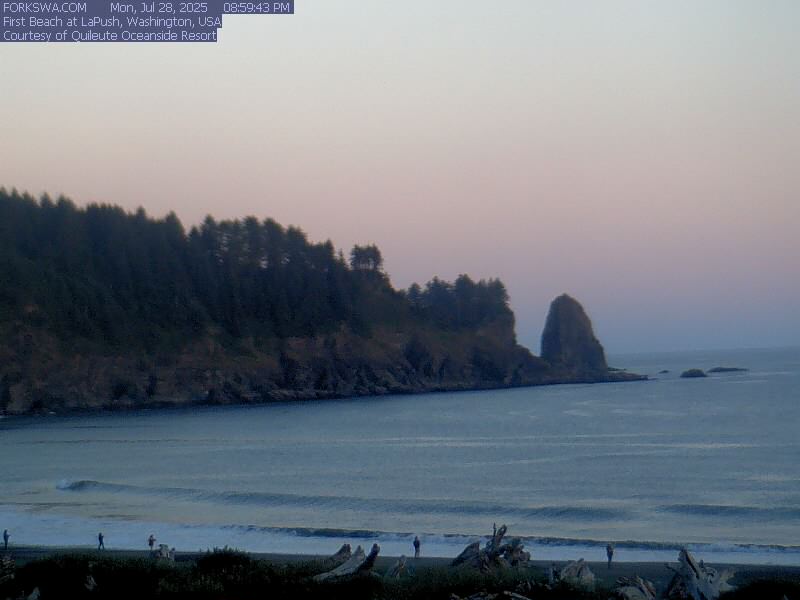
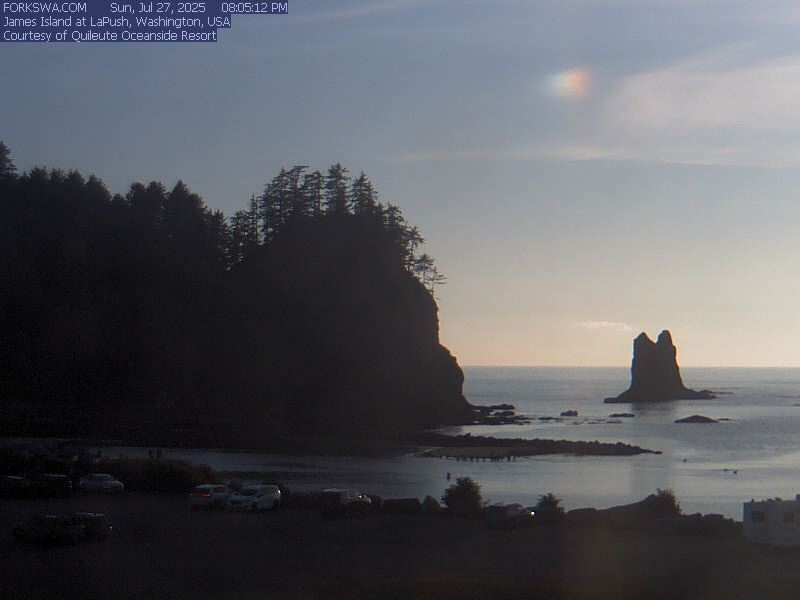
Once more continuing to fail to see gray whales. Insert here a rerun of Saturday's First Beach photos. On the other hand, the elk were out on Beaver Prairie; it is surely ridiculous to fuss about the absence of cetaceans when the Olympic Peninsula offers its own charismatic megafauna, just casually, in a field by the highway.

Sunday was a beautiful spring morning at Rialto Beach, I got my COASST surveys for April done (no dead birds). There's more wrack than there had been for a while, and marine debris on the beach, nets, bits of rope, Asian plastic bottles from the North Pacific garbage patch.


Then I drove around to the La Push side of the river and not-saw gray whales for a couple of hours. Oh. I already mentioned that. It did occur to me that perhaps there just weren't any whales passing by when I happened to be looking— it's not like they could show up one after another all up and down the migration route simultaneously.
PS Saturday's unrecorded bird events included an eagle sitting in the shallows of the Quileute River, just sitting there, the way I used to sit in Tassajara Creek in the afternoons when the temperature would be around 110 degrees and nothing remained of my temper.

And there were lovely ducks paddling around in the river. I got a good look at one in the binoculars, a common merganser of such surpassing beauty that I wondered if I had maybe been a female merganser in a previous life to respond to it so clearly.
Sunday afternoon I stopped by the lake and a pair of mallards waddled up attentively: was I eating? would I share? They were both so drop-dead gorgeous, suddenly not just boring old mallards, it occured to me that oh it is spring and the birds are in their breeding colors and no surprise even passing elderly primates respond. Mrs. Mallard flashed her purple iridescent speculum at me repeatedly. I actually don't believe this is projection: she was flirting. I considered giving her the remains of my lunch...

The cam on Hurricane Ridge is clear of ice.

But I'm not going up there. Heading west again:

Saturday it was rainy in the morning, but eventually I got rolling and went West. It was like being surprised by the expected: it was gray and rainy and beautiful along Lake Crescent, the oldgrowth lowland forest on the lakeshore by Barnes Point was dense and mysterious and some of the trees are BIG, there was leftover snow by the highway past the Fairholm store though the elevation is only around 1000'. It quite seriously rained for a while, but was lifting by the time I got to La Push.
I was looking for gray whales, the blowing breaths and stray bits of whale backs of the northward migration now in progress. No whales. There are rarely any whales when I am looking. (Other people see them, plenty of reports.)


Eagles over the water, yes. Surfers, yes. Fishing boat traffic, twilight tourists, sound of waves, clearing skies, yes.

From there you can see the beach where I usually go except in failing-to-see-whales season, but to actually get there you have to drive east up the highway, get across the river, then back west again. I did that. Walked to Ellen Creek and back.

I came home. It was fairly beautiful out, even back here in town.

The cam on Hurricane Ridge is all iced up, too bad, it must be gorgeous up there at the moment. Here instead is the south-facing view from the airport cams:

It's a spiritual sin not to be at the ocean right now, but today's a work-at-the-college day.

The ferry horn just sounded, it's pulling away from the dock.

It's good to be home. Gotta go to work now.
Near the end of the visit, another expedition with M. (whom I've known since junior high school and very little in the intervening decades). We went to Morikami Gardens. Lunch in the cafe, walk around the garden loop, visit the museum. My perhaps insufficiently reverent take: that it's a little odd, Florida water and Florida plants being trained to a Japanese sensibility by people a long way and a number of generations from Japan.
The best part was when we sat on a bench on the bonsai island and watched turtles and koi and birds work the murky shallow water. All the wildlife was very tame. There was a Florida mottled duck. There were wonderfully patterned turtles swimming around. There was a quite astonishing bluejay, with blue and black checkerboard wings, which it turns out is commonplace everywhere except anywhere I have lived in the Western states for the past 45 years. A great blue heron came down right in front of us and waited to see something he might be able to eat (the koi were too gigantic, ducks out of his league, turtles too large and too hard of shell). Now and then a wind flexed his/her long plume-like neck and back feathers dangling down.
I managed to refrain from firing up the mifi unit right on the spot to get online and find the line of poetry which came to mind. Wallace Stevens, it turns out. Of Mere Being.


Saturday, came home. Port Angeles/Seattle/Chicago/Fort Lauderdale going. Fort Lauderdale/New Orleans/Las Vegas/Seattle/Port Angeles returning.


Day Six in Florida. On day three I spent the late afternoon and supper time with a friend whom I knew in junior high. She used to come on family vacations with my mom, my sister and me. Before my stepfather came on the scene, when the three of us were the whole family, fifty-plus years ago. Hadn't seen her for some decades, until last summer.
We spent a long time making bad driving decisions looking for a little county park called the Secret Woods Nature Center. Despite the heat. It had a butterfly island, with wonderful signs to say what species of butterfly larvae or nectar-eating adults feed on each thing in the garden, it worked, there were butterflies. Flitter flitter. Then we went on a boardwalk trek though (dry in this season) cypress and mangrove woods and so on, out to a river called the New River, and suddenly on the other side of the water, huge homes and fancy boats. And all the time the sound of interstate 595 and state highway whatever#, and planes from the Fort Lauderdale airport low overhead. It really is a Secret Woods, you'd never imagine it was there.
Um yeah, it was horridly hot, but a breeze had sprung up so we survived. I took pictures, but for the first time in my whole electronic life, I have forgotten the cord that unloads the camera.
Anyway, the expedition was such a success, and I am here for such a long visit, that we are going to do a rerun next week, it will have to be earlier in the day as we want to go to a famous Japanese garden, Morikami Gardens, and they close at 4.
Other than that, we are doing ok here, in a long tedious sort of way. People here are really really old. If there are ibises on the grass outside the diningroom window at the assisted living place, we can spend a really long time discussing whether they are ibises or cranes, and whether it is spelled 'ibis' or 'ibix'.
In the Olympic Mountains this spring, there is a heck of a lot of water locked up in the snow. 175%-200% of average. Ditto near Nevada City, California, where I have friends who keep getting snowed in...

At the Waterhole Snotel on Hurricane Ridge, it's looking like if we don't get a warm wet storm to help it along, the road to Obstruction Point might not melt out until August...

Up the Dungeness, too.

PS for R&R, and VW. I don't know which of the SnoTel sensors on this map we should be looking at...
The Park website says there are 146" of snow at the stake.
Thursday/Friday I drove up to visit friends in Surrey, just across the BC mainland border. The drive includes a ferry crossing, as well as a border crossing. I got to ride on the brand-new Chetzemoka, launched last fall. Quite a different experience, being on a ferry which is crisp and fresh all over, rather than several decades old and lumpy with many layers of maintenance paint.


Back home, on Saturday at the end of the day I went out to the library, and to the supermarket, where I saw on the newspaper that the orcas had stayed around the harbor a second day. So then I went out on the Hook (in the rain) in case they happened to be hunting seals anywhere I could see. (These were mammal-eating transient orcas who passed by, not the fish-eating resident orcas I go watching at Port McNeill.) No orcas. Also no ships.
But there was a lot of bird action. Some brants (a truly beautiful small goose); a couple of flocks of Canada geese honking past; a small mixed group of ducks, one pair each of several species. It was like a children's picture book: "Mr&Mrs Goldeneye, Mr&Mrs Widgeon, Mr&Mrs Bufflehead and Mr&Mrs HarlequinDuck all went paddling in circles together down at the harbor." A young eagle came flapping down out of the sky. A couple of gulls were quite excited when he came in. I thought he was going to attack one of the ducks, but no, he landed on the rocks and tiptoed around quite uncomfortably, then flew off with something small in a talon.
Last month I failed Oiled Birds 101 ("intake and stabilization"). The most important thing to learn is to be calm and move slowly and quietly when handling distressed wildlife. My team's practice duck was very freaked out and it freaked me out. Poor Zipper had to go back into his carryall to calm down, and there was nothing to be done about me.
Longer version of Oiled Wildlife Basic Intake and Stabilization, from a letter to a friend:
We worked with dead birds and live ones. The trainer has ducks, and they are moderately used to being handled at wildlife trainings. We were doing intake and assessment. After we practiced using dead ones, handling birds and finding their various parts and putting in feeding tubes and finding the vent so we can take the temperature and so on, my team had a large male mallard named Zipper to weigh and band and listen to his heart and take his temperature and examine every inch and draw blood (such a long list of invasions), and Zipper did not want to play. He was very mad and very stressed.Eventually he was returned to his carrier, and a team who had already finished passed on a sweet little duck named Pearl who didn't mind nearly as much, but by then I too was very stressed. Someone pointed out that in real life ALL the birds we worked on at a wildlife rehab center in a spill will likely be at least that upset and difficult to handle, but I said that in real life we'd be helping the bird, not just harassing it for our own purposes.
Though Zipper was difficult, a very important part of what we were supposed to learn was to talk softly and be as calm as possible, which helps the birds. At which I entirely failed. So poor Zipper was also suffering from my being worried and overexcited about him. The teams that designated one person to hold their duck in their lap and transmit quietness to it did much better. Maybe when the oil spill comes I'll not be able to be assigned jobs that involve handling birds and putting tubes down their throats (the first desperately important thing is to hydrate them; even if they are also starving, liquids first...)
I want to say, about the trainer, that she loves her ducks, and remembers as individuals and with attentive love the oiled birds she has rescued, and the swans caught in barbed wire, their physical condition, how they responded. She tells stories about particular rescues and treatments totally from a place of devotion to helping them, and she is teaching people how to volunteer to do it so other future birds can be helped. Bird science, animal rescue of various sorts, and oil spill events all depend on trained volunteers. But I'm not sure it will be me with a distressed sentient being in my hands.
Tuesday morning early I leave for Florida, for family stuff. Don't know that I'll have much to tell, or take pictures of, until I'm home again.
There were orcas in Port Angeles harbor Tuesday afternoon. (1). Where was I? At the laundromat, a few blocks away, all unknowing. It's not even the first time that happened...
Peninsula Daily News says the North Pacific gyre will begin bringing us debris from the tsunami in northeastern Japan in about two years
It was a desperately beautiful day at the ocean.
Surveying for beached birds at Rialto Beach, my monthly assignment for COASST. No dead birds on the Ellen Creek segment. Not so much in the way of live ones either, except little birds singing a lot in the woods behind the beach, who seemed to be mostly robins. No eagles. Nothing to find in fact, except a cleanswept beach, the gravel and sand smoothed up the slope.

The pink sand was evident for the first time in a long time. Rau describes the same sand on Second Beach. The color comes from grains of garnet. "These heavy minerals were originally in the Pleistocene or ice age deposits that cap bedrock in this area. They have since been eroded from the Pleistocene deposits and brought to the beach by streams where, because they are relatively heavy, they have been concentrated along the beach by wave action." It's one of those explanations that are just a mystery.

Nothing to find on the Rialto Jetty segment either.

It was hard to pay attention to looking for beached birds, because I knew the minute I set foot on the beach that there wouldn't be any. There was no wrack, no litter except far back in the drift. Obviously anything the size of a dead bird would be either carried away or already buried in gravel unless it arrived just now. Whole trees are buried in that gravel. But dutifully I looked, special attention to the drift, eyeballing across the whole sweep of beach where there was nothing nothing, and then along the surf line returning, and looking looking looking.


So then I went to First Beach to fail to see the gray whales passing by. No whales. (No whales on Sunday either, a trip so unexciting I didn't even post about it.) A harlequin duck and a surf scoter in the river. A nice sea lion manifestation in the mouth of the river, and Quileute fishermen in little boats setting and moving nets with floats. I think the humans and the pinniped were all after steelhead. There were surfers, and lots of people coming and going to walk on the beach. Nobody else seemed to be looking for gray whales, which is just as well as they don't seem to have been passing by today.


P.S. The elk were out on Beaver Prairie when I was heading west.
The only thing I did Saturday was wander fairly thoroughly over the lot with the trees in it, to notice what is growing there. Photos are hard; except as seen from my window I haven't gotten a communicative picture. And from my window it looks like a little piece of forest, which it is not. This is not just about this tree-y lot, it is damn near impossible anywhere to get a picture that says 'trees here' when you are standing among them. A frame full of trunks and litter doesn't do it. Plus Saturday I dawdled around until the sun had clouded over. What I found was lots of dismal trash and
small madrones
about five really large madrones
douglas fir small and moderate, one moderately tall
one cedar
an amelanchier budding
salal
at least one alder, moderate size
lots of scotch broom around the margins
a broad-leaved evergreen shrub/small tree.

Have entirely failed to identify Mr. Broadleaved Evergreen. It could of course be not native, and thus not in the books, as the several spring bulbs I saw scattered around are not. Crocuses, and a maybe a daffodil. A yellow something like that, are there yellow narcissuses?
I have also lately spent some time on the phone with the county and found out who owns the parcel facing me, though I now realize there are actually 3 undeveloped parcels, the other two facing across the larger street, together occupying half a block. This does not tell me what I need to know, which is, was there EVER a house there, or was it just logged over and unaccountably left empty in this long-settled neighborhood? When was it logged, or was it (saw no stumps), and how old are the really large madrones?? Are the crocuses evidence of some vanished house's vanished garden? Why are some of the un-housed lots in this neighborhood covered with trees and others all grass.
And what will Mill Creek Construction do with parcel #02-4556 if the economy ever allows, or do they just hope to flip it, and who did they buy it from, and why has nobody actually done any new construction in this old neighborhood for what appears to be several decades. My house dates from the 1950s, and the others all look older.


Jennifer Howard asked a question in her blog post, Doubting Digital Durability, and I found myself in a twitter conversation with her and with @RepoRat, Dorothea Salo. Kind of like conversing with the NetGods.
I wrote a comment for Jen's blog, and it won't post. Yaay technology. So here it is:
Scattered thoughts:
I lately bought a paperback published in 1953. It crumbled as I read it, though I was extremely careful, scarcely opened it far enough to read the lines of type.
But I also once held in hand a book published by Aldus' press in 1515. This was the year he died, so probably not literally an Aldine edition but rather the work of his successors. Still, the book was nearabouts 500 years old, and almost touching Aldus himself across time: my hands remember holding it, with reverence, not wanting to let it go.
Paper persists, as Walt Crawford said in 1998 ("Paper Persists: Why Physical Library Collections Still Matter." Online 22:1 (January/February 1998): 42-48.) The old link I had to the article itself has not persisted, but you probably can find it somewhere.
Mir S. and I did Santa Fe Poetry Broadside, a digital poetry magazine, from 1998 to 2009. When we stopped, we were certainly not of the same mind about what should become of it. To me, from the moment we started, Santa Fe Poetry Broadside was the entirety of what we had published, all at once. To my co-editor, it was an ephemeral publication by definition and by name, a Broadside; and the best of each poet's work would find its way to print; or not. To me, those poems we published are retroactively not-published if we allow them to evaporate.
It's archived in LOCKSS, but LOCKSS is a dark archive. The Santa Fe Poetry Broadside as we intended it vanishes utterly from the web if I miss one payment to my ISP. LOCKSS will migrate its data as technology changes, yes, and thank you so much, LOCKSS; nevertheless, if I want the Broadside to remain alive on the Web, the curation 'technique' is to pay forever.
@RepoRat thinks I could find another Repository to archive it. Then I'd only have to keep up payments for our domain name. Bottom line: it's a (very) Little Magazine, but unlike the ones on my bookshelves, it needs my will to persist.
I did care about the blogging I did for my former place of work. I was a library's voice behind the curtain for 30 months. It was work that wasn't quite mine, and I had to leave it behind. Almost 4 years on, they seem to be taking good care of it. As to this present blog, I really don't know what to think. It doesn't touch my professional work, but is the record of going on four years of my life. This will eventually matter to whom? exactly why?
We now return you to something like our regular programming. I might have something to say later today about the lot across the street, the one inhabited by trees (and trash). But first I need to think for a while about Libyan journalist Mohammad Nabbous, who was killed last night. #libya #libya #libya #japan #bahrain #yemen #libya
It's just flat astonishing that the tsunami came all the way across the ocean, at the speed of a jet plane, and then it was here.
Spent the morning at the tribe. I had actually more or less planned to play hookey from the tribal library and go do a beached bird survey, but by 1:30AM the county emergency folks were reporting a tsunami watch and saying to stay off the beaches (but no flooding likely). The central area at Lower Elwha is right down at Strait level. The tribe went through its whole Emergency Operations routine, and as a precautionary measure went house-to-house waking up everyone on the Rez at 6:45 AM and requiring them to evacuate up the hill to the prepared emergency shelter.
I watched the First Beach web cam, couldn't see anything that I was sure was anything but surf. But look: the blue line is the predicted tide, the red line is the water level observed on the gauge, the green line is the difference between the two. Sure enough, there were several waves, and the water level receded and then rose for each, and the biggest wave was not the first but a later one.

There was only about a 6-inch surge in Port Angeles harbor; and as you see, about 2 feet at La Push.
Santa Fe, March 25, 2005. This image is for the mystery authors who will be in Santa Fe at the end of the month and are hoping for desert flowers and sunhats as amenities of the Left Coast Crime 2011 convention. Blue skies, forsythia and fruit blossoms are more likely than snow, but it's too soon to know...

Heavy rain in the night. The river hopped up, but not very high,

the water is staying in the mountains as snow the way it is supposed to. The Olympics are doing quite well as to both precipitation and snowpack,

though the Cascades are only just around normal and had been forecast to be very high precip this year because it's a La Nina year. Santa Fe where I used to live is dry, and Tucson where my mom used to live is only at something like 35% of their already skimpy normal...

Cliff Mass' post has nice imagery about the present rainstorms. Note the smaller yellow blob of pouring rain right here at 10 o'clock last night.