Saturday, May 14, 2011

As Green As It Gets

Full spring on the west side of Port Angeles. Everyone's grass is as green as it gets; evenings and weekends buzz with lawnmower sounds. Wild things are blooming, the madrones and bitter cherries and amelanchier. The yards are blooming, rhododendron and tulips everywhere, fruit trees, the flowering quince in the lot across the street, daffodils... All this just vivifies the garden ornaments, yard figurines, paint details, benches. MP told me once this was originally a neighborhood of mill-workers' cottages, though it's hard to find one now that has not been expanded, enhanced, or replaced decades ago by a double-wide mobile home. Each one wears a costume of detail, plain or fancy or lunatic.

Evening neighborhood walkabout:

The Purple Fence, May 12, 2011 (Click for larger image.)
..., May 12, 2011 (Click for larger image.)

Rhododendrons are native up in the mountains, though probably not blooming yet. There is still a LOT of snow. Down here they do well, but have to be planted.

Rhododendrons. (Click for larger image.)
Gardens Are Not My Thing, But Can't Help Noticing (Click for larger image.)

Madrone in Full Bloom in the Lot with the Trees (Click for larger image.)
Rainbow Picks Out the Coast Guard Station at the End of Ediz Hook (Click for larger image.)

Tuesday, May 10, 2011

Re-Mapping the Drive-Around

Driving route from Rialto Beach to La Push. You can see the school and the old coast guard station readily from Rialto Beach, it looks like it's Just Over There. Which in fact it is if you have a boat. The blue line on the map is much easier to see here than in previous view: Live link here so you can play with it:

Driving map, showing road and beaches (Click for larger image.)

MP just emailed from Mendocino to say, "The whales are supposed to be passing in great numbers. Tomorrow I will see them." Well then, if great numbers of gray whales are off Mendocino, those whales aren't here yet, so I haven't Not-Seen them yet. So will keep trying. :-)

Map showing context, here to there:

Blogging question: shall I go back and put the new, more-legible, driving map in Friday's post... Um, yeah.

Monday, May 09, 2011

Who, Me? I Did What? Where?

Stopped between part one (surveying for dead birds at Rialto Beach) and part two (failing to see gray whales at La Push) of my day,

North end of Rialto Beach, May 8, 2011 (Click for larger image.)

to pick up the verizon signal at the pullout over the north side of the river: checking my mail and also checking on developments certain twitter people are sharing, whom I care about though I've never met them in real life. Then drove around to the south side.

Summary Report: No birds to record on the COASST survey forms, and no whale blows that I could see.

Tried looking for whales from a different spot, at the south end of First Beach, by Lonesome Creek.

First Beach, La Push. May 8, 2011 (Click for larger image.)

I hadn't charged the camera nearly long enough, had to be frugal with photos. Luckily found no birds which must be documented. Though obsessively struggling all day with the online maxim, 'Pix or it didn't happen,' a most pleasing day happened. It was seriously beautiful out.

It's official, I have gotten through the entire gray whale migration season without a single sighting from the beach. By Lonesome Creek on Sunday there were surfers yes, families running around yes, unbelievable beauty yes. No whales.

The School at the Edge of the World, First Beach, La Push, May 8, 2011 (Click for larger image.)

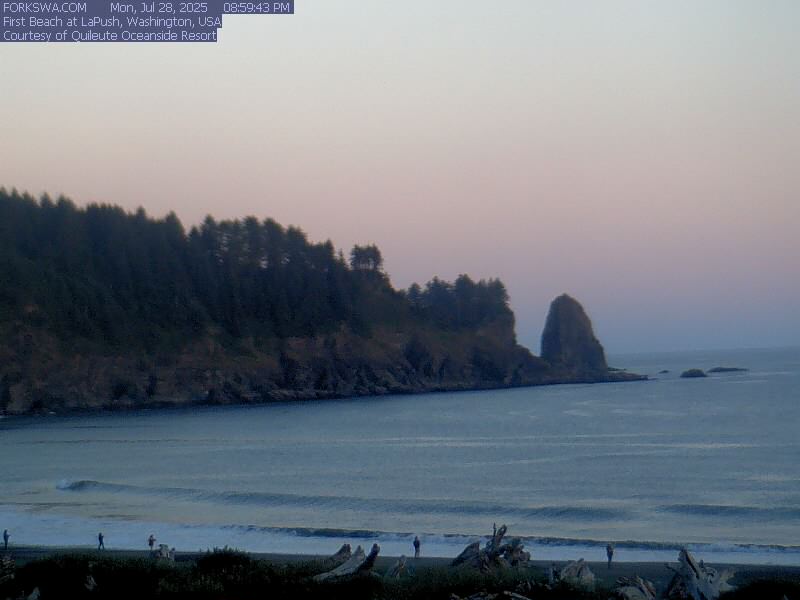
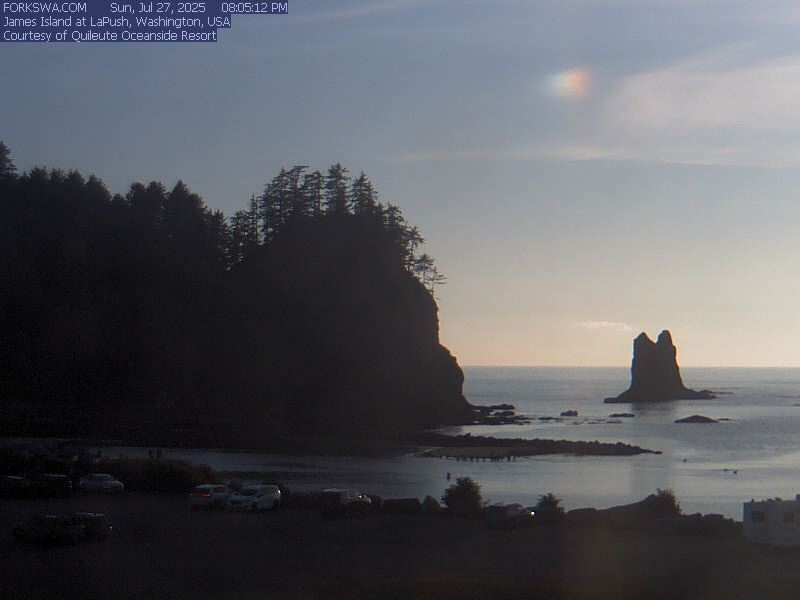
Closeup view of the Quileute Tribal School. School on the left; present-day administration building, formerly the Coast Guard station, on the right. The First Beach web cams (1)(2) are in the attic of the old building, looking out in opposite directions.

La Push, detail

Friday, May 06, 2011

Changes Coming in the Place I Always Go

A bill has been introduced by our Representative, Norm Dicks, and our Senator, Maria Cantwell, regarding land transfers from Olympic National Park to enable the Quileute to move the school and senior center and certain other buidings up out of the tsunami zone. This is a process which began long before the recent tsunami in Japan, and events have made its importance clear. There are news stories (1) (2)(3) (4) (map). The school in particular is right on the beach at the edge of the world. It's the building with the blue roof.

This is a map from Handbook of North American Indians: Volume 7—Northwest Coast, published by Smithsonian Institution Press, reproduced here with permission. Notice along the left edge, the dark spots representing present-day reservations of the Quileute and Hoh tribes.

"Fig. 1. Territory of the Quileute in the mid-19th century" from page 432 (Click for larger image.)

Next, below, is part of a map kindly sent by Olympic National Park, showing an overview of the area in which land is being given to the Quileute tribe to move some parts of the tribe's central area out of the tsunami zone. I have somewhat tilted and cropped the map in a not-very successful attempt to make it show the same area as the 19th century map above. (The original unedited map is here.) Notice along the left edge the circle enclosing the area of the present Quileute reservation and the 780 or so acres which are being shifted or redesignated. (The Hoh Reservation is also making moves to get itself out of the tsunami zone, but not in this bill.)

About the same area on about the same scale, location of the areas covered by the Bill (Click for larger image.)

Here is what they are planning to do in that tiny area on the far western edge of the Quileute's one-time territory. The tribe gets back some land, and in exchange they agree to permanently and formally allow access across reservation land to the National Park's lands at Rialto Beach and Second Beach. (There are lots of other complications in the bill.) Thank-you to Olympic National Park for sending this map also.

Olympic National Park Proposed Boundary Revision (Click for larger image.)

OK then. As you know, I go to Rialto Beach most often, and sometimes in whale season to First Beach on the reservation at La Push, and sometimes to Second Beach. I'm going tomorrow. Maybe it's not too late in the season to see or fail to see gray whales at First Beach. Maybe I'll do this month's beached-bird survey at Rialto.

How You Get From the North Side of the Quileute River (Rialto Beach) to the south Side (La Push) If You Don't Have a Boat (Click for larger image.)

Just as a reminder, the whole of my beach life takes place in this small bit of the Quileute's original territory.

Sorry for shortcomings of graphics skills, and any errors in telling things clearly. I've left out all the history. Not mine to tell. But I have my own relationship to the territory.

Tuesday, May 03, 2011

Ceaseless Birdsong

Saturday morning, in the Fraser Valley, BC. Reifel Migratory Bird Sanctuary. It's at the mouth of the Fraser River Estuary, though even up on a viewing tower on a sunny day, where you can see north and south along and across Georgia Strait, it's hard to make out what is the main river channel, etc. It's all so FLAT out there.

Looking Across the Fraser River from up on the Viewing Tower. That might be Steveston on the Other Side. (Click for larger image.)

It's the quiet season at Reifel (pronounced 'rifle'). The thousands of snow geese have gone back to Siberia, and the hundreds of sandhill cranes —except for one resident pair— headed on up the coast to Alaska. Only the birds that stay local are there. We saw Canada geese on the nest, and goose families, and several times were threatened on the path by goose parents hissing at us determinedly. A Canada goose with his neck stretched up and his tongue vibrating at you while he hisses is actually quite threatening for a short person. Personally I'd think they'd be better advised to nest further from the path so people don't come too close, but then what do I know, I'm not a goose.

Canada Geese with Goslings, Reifel Migratory Bird Sanctuary, May 1, 2011 (Click for larger image.)

Mother Goose Resettling Herself (Click for larger image.)

Lots of resident ducks, too. Mallards of course. Wood ducks. Shovellers, pintails. Also we had some Greater White-fronted Geese, which we had a hard time figuring out what they were, except that once we figured it out it was so obvious.

Any Day With Northern Pintails In It Is a Very Good Day (Click for larger image.)

Reifel's style differs from the Bosque del Apache in New Mexico, the wildlife refuge I'm most familiar with. The fields where farmers are contracted to raise grain for the birds are outside the Sanctuary itself, in the farm fields of Westham Island. In season, the snow geese fill the fields by the roadsides. There are lots and lots of numbered nesting boxes on tall poles stuck out in the ponds and mudflats of the Sanctuary. It's fun to imagine volunteers going around with clipboards, tracking and taking notes. "Hmm, tree swallow family in #164. Redwing blackbirds at #87."

Lots of little birds, towhees and redwing blackbirds and swallows and sparrows and nuthatches and and... Birdsong pervading everywhere, like a dawn chorus, but lasting all morning.

Tower on the main walking loop. (Click for larger image.)

Thursday, April 28, 2011

Where I'm Going

Long weekend in another country. Arriving mostly by land, well, except for the ferry ride from Port Townsend, and the bridge over Deception Pass...

... (Click for larger image.)

Anticipating Marmots

Still snowing up there. I wonder if there are years when the road out to Lillian Ridge never is opened at all? Last year it was open only mid-July to mid-October. Marmots. I need to be able to anticipate marmots.

The Waterhole SnoTel, halfway out to Obstruction Point on Hurricane Ridge (Click for larger image.)

Sunday, April 24, 2011

Friday the Duck Was At the Heritage Center

(Staying local, apparently.)

It's Duck Derby season, an annual fundraiser for the local hospital. The ridiculous beast appeared across the street from the post office in front of the Elwha Klallam Heritage Center on Friday, but then wasn't there anymore. No worries. Now he's at Safeway. I'm thinking I might actually buy a number this year. (I don't think you actually get a rubber duckie. Your numbered duckie gets dropped in the canal on the morning of the derby, and bobs along where he will, preferably across the finish line.)

Giant Duck Balloon (Click for larger image.)

In the lot with the trees there's a big shrubby plant with coppery leaves and spectacular pink flowers. C. says it's a flowering quince— therefore definite evidence (along with the nearby daffodil) of a former garden on the lot.

Flowering Quince Chaenomeles japonica in the Lot With the Trees (Click for larger image.)

I went down to Ediz Hook. There was a lot of ship action. Most interesting and baffling, the Evergreen freighter that came out of Puget Sound just to drop off its pilot before heading straight into Canadian waters, curving back east en route to Vancouver. Not clear what else they could have done (no pilot station at Port Townsend, though I thought there was), but the track sure looks peculiar on a map.

Ever Urban (note the pilot boat off the stern) (Click for larger image.)
Her Track (Click for larger image.)

There were two tankers and a freighter in the harbor on Friday afternoon, and today there's a log ship, Kiwi Trader, loading at the T-pier; I might go out later and try to get a picture of her.

I'm actually apparently devoting the weekend to reading, mostly mowing through library books which are either almost due or have many other library patrons waiting for them, or both. I was so into Postmistress, Mora, Wash., 1914-1915 : journal entries and photographs of Fannie Taylor that I dreamed about her: there I was at Mora, lacing up my boots to hike to Second Beach, well within Fannie's territory. We were talking a little about what freedoms women have today (not much freer than the life Fannie led!), and I knew I was dreaming and was so grateful to meet her. I think I'll write to Jacilee Wray, the editor, and ask if I can see some of the originals of Fannie Taylor's photographs. The Park has them in their archives.

Monday, April 18, 2011

Enough With The Ocean, Day After Day

Once more continuing to fail to see gray whales. Insert here a rerun of Saturday's First Beach photos. On the other hand, the elk were out on Beaver Prairie; it is surely ridiculous to fuss about the absence of cetaceans when the Olympic Peninsula offers its own charismatic megafauna, just casually, in a field by the highway.

Elk on Beaver Prairie, April 17, 2011 (Click for larger image.)

Sunday was a beautiful spring morning at Rialto Beach, I got my COASST surveys for April done (no dead birds). There's more wrack than there had been for a while, and marine debris on the beach, nets, bits of rope, Asian plastic bottles from the North Pacific garbage patch.

Not much swell, Rialto Beach, April 17, 2011 (Click for larger image.)
James Island from Rialto Jetty, April 17, 2011 (Click for larger image.)
Kelp Ashore, April 17, 2011 (Click for larger image.)

Low Swell, Not Much Surf, Rialto Soundscape for Cee, April 17, 2011

Then I drove around to the La Push side of the river and not-saw gray whales for a couple of hours. Oh. I already mentioned that. It did occur to me that perhaps there just weren't any whales passing by when I happened to be looking— it's not like they could show up one after another all up and down the migration route simultaneously.

PS Saturday's unrecorded bird events included an eagle sitting in the shallows of the Quileute River, just sitting there, the way I used to sit in Tassajara Creek in the afternoons when the temperature would be around 110 degrees and nothing remained of my temper.

Eagle in the Quileute River, Rialto Beach, April 17, 2011 (Click for larger image.)

And there were lovely ducks paddling around in the river. I got a good look at one in the binoculars, a common merganser of such surpassing beauty that I wondered if I had maybe been a female merganser in a previous life to respond to it so clearly.

Sunday afternoon I stopped by the lake and a pair of mallards waddled up attentively: was I eating? would I share? They were both so drop-dead gorgeous, suddenly not just boring old mallards, it occured to me that oh it is spring and the birds are in their breeding colors and no surprise even passing elderly primates respond. Mrs. Mallard flashed her purple iridescent speculum at me repeatedly. I actually don't believe this is projection: she was flirting. I considered giving her the remains of my lunch...


Mrs. Mallard on a Log, Lake Crescent, April 17, 2011 (Click for larger image.)

Sunday, April 17, 2011

Oooh Look

The cam on Hurricane Ridge is clear of ice.

But I'm not going up there. Heading west again:

Webcam at First Beach (Click for larger image.)

Failing-To-See-Whales Season

Saturday it was rainy in the morning, but eventually I got rolling and went West. It was like being surprised by the expected: it was gray and rainy and beautiful along Lake Crescent, the oldgrowth lowland forest on the lakeshore by Barnes Point was dense and mysterious and some of the trees are BIG, there was leftover snow by the highway past the Fairholm store though the elevation is only around 1000'. It quite seriously rained for a while, but was lifting by the time I got to La Push.

I was looking for gray whales, the blowing breaths and stray bits of whale backs of the northward migration now in progress. No whales. There are rarely any whales when I am looking. (Other people see them, plenty of reports.)

First Beach at La Push, Looking to the South. No Whales, April 16, 2011. (Click for larger image.)
First Beach at La Push, Looking at James Island. No Whales, April 16, 2011 (Click for larger image.)

Eagles over the water, yes. Surfers, yes. Fishing boat traffic, twilight tourists, sound of waves, clearing skies, yes.

Fishing Boat in the Channel (Click for larger image.)

From there you can see the beach where I usually go except in failing-to-see-whales season, but to actually get there you have to drive east up the highway, get across the river, then back west again. I did that. Walked to Ellen Creek and back.

The river overlook. Quileute River, the jetty, James Island and Pacific Ocean Beyond (Click for larger image.)

I came home. It was fairly beautiful out, even back here in town.

The Road Home: Lake Crescent, April 16, 2010 (Click for larger image.)

Thursday, April 14, 2011

Looking Around

The cam on Hurricane Ridge is all iced up, too bad, it must be gorgeous up there at the moment. Here instead is the south-facing view from the airport cams:

... (Click for larger image.)

It's a spiritual sin not to be at the ocean right now, but today's a work-at-the-college day.

First Beach Web Cam (Click for larger image.)

The ferry horn just sounded, it's pulling away from the dock.

Webcam on top of Port Angeles Inn (Click for larger image.)

It's good to be home. Gotta go to work now.

Sunday, April 10, 2011

Fire-fangled Feathers Dangle Down

Near the end of the visit, another expedition with M. (whom I've known since junior high school and very little in the intervening decades). We went to Morikami Gardens. Lunch in the cafe, walk around the garden loop, visit the museum. My perhaps insufficiently reverent take: that it's a little odd, Florida water and Florida plants being trained to a Japanese sensibility by people a long way and a number of generations from Japan.

The best part was when we sat on a bench on the bonsai island and watched turtles and koi and birds work the murky shallow water. All the wildlife was very tame. There was a Florida mottled duck. There were wonderfully patterned turtles swimming around. There was a quite astonishing bluejay, with blue and black checkerboard wings, which it turns out is commonplace everywhere except anywhere I have lived in the Western states for the past 45 years. A great blue heron came down right in front of us and waited to see something he might be able to eat (the koi were too gigantic, ducks out of his league, turtles too large and too hard of shell). Now and then a wind flexed his/her long plume-like neck and back feathers dangling down.

I managed to refrain from firing up the mifi unit right on the spot to get online and find the line of poetry which came to mind. Wallace Stevens, it turns out. Of Mere Being.

Saturday, came home. Port Angeles/Seattle/Chicago/Fort Lauderdale going. Fort Lauderdale/New Orleans/Las Vegas/Seattle/Port Angeles returning.

Monday, April 04, 2011

(Revised) Visuals from Florida

Palmetto in the Secret Woods, Dania Beach, Florida (Click for larger image.)

Butterfly Sign in the Secret Woods, Dania Beach, Florida (Click for larger image.)

Ibis Through Mom's Window, Tamarac, Florida (Click for larger image.)

Sunday, April 03, 2011

Secret Woods, and Ibises

Day Six in Florida. On day three I spent the late afternoon and supper time with a friend whom I knew in junior high. She used to come on family vacations with my mom, my sister and me. Before my stepfather came on the scene, when the three of us were the whole family, fifty-plus years ago. Hadn't seen her for some decades, until last summer.

We spent a long time making bad driving decisions looking for a little county park called the Secret Woods Nature Center. Despite the heat. It had a butterfly island, with wonderful signs to say what species of butterfly larvae or nectar-eating adults feed on each thing in the garden, it worked, there were butterflies. Flitter flitter. Then we went on a boardwalk trek though (dry in this season) cypress and mangrove woods and so on, out to a river called the New River, and suddenly on the other side of the water, huge homes and fancy boats. And all the time the sound of interstate 595 and state highway whatever#, and planes from the Fort Lauderdale airport low overhead. It really is a Secret Woods, you'd never imagine it was there.

Um yeah, it was horridly hot, but a breeze had sprung up so we survived. I took pictures, but for the first time in my whole electronic life, I have forgotten the cord that unloads the camera.

Anyway, the expedition was such a success, and I am here for such a long visit, that we are going to do a rerun next week, it will have to be earlier in the day as we want to go to a famous Japanese garden, Morikami Gardens, and they close at 4.

Other than that, we are doing ok here, in a long tedious sort of way. People here are really really old. If there are ibises on the grass outside the diningroom window at the assisted living place, we can spend a really long time discussing whether they are ibises or cranes, and whether it is spelled 'ibis' or 'ibix'.